
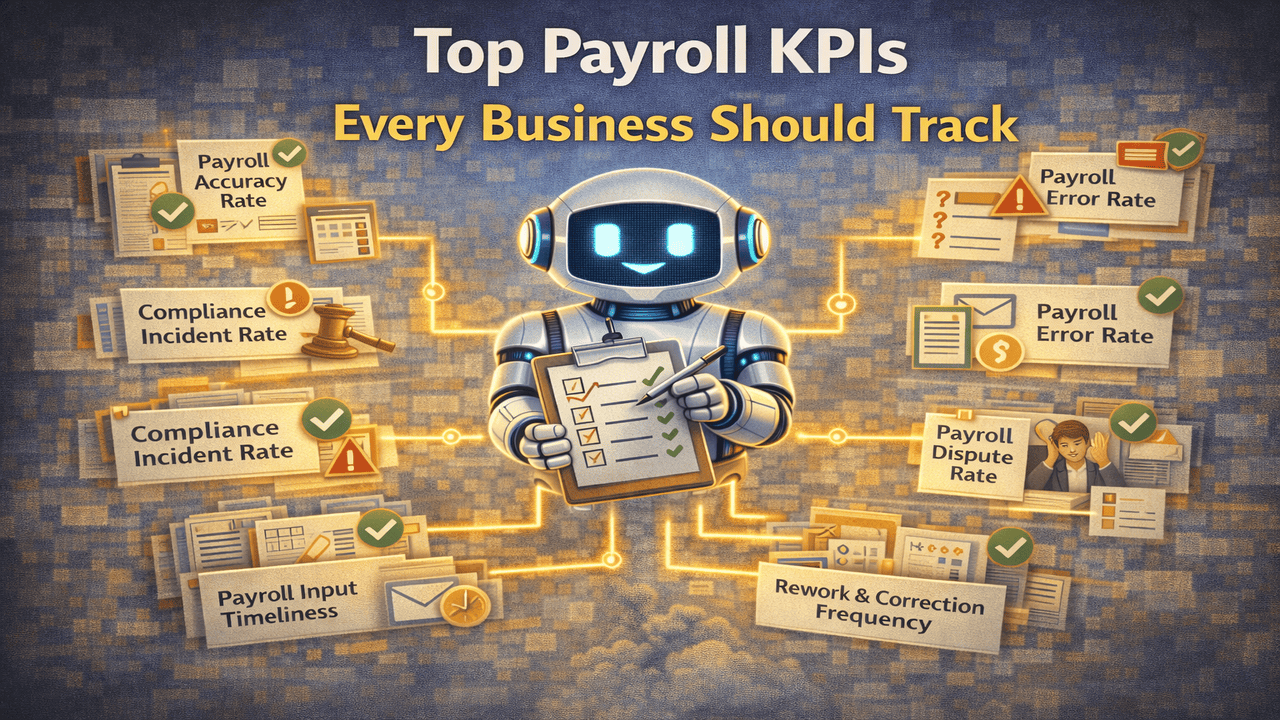
Payroll isn’t just about paying salaries on time.
It’s a business-critical operation that impacts compliance, employee trust, and financial health.
Yet many businesses don’t track payroll performance properly.
They ask:
- “Did payroll run?”
- “Did anyone complain?”
But they don’t ask the questions that actually matter.
That’s where payroll KPIs come in.
🧠 What Are Payroll KPIs?
Payroll KPIs (Key Performance Indicators) are metrics that help businesses measure:
- Payroll accuracy
- Process efficiency
- Compliance health
- Operational risk
Tracking the right KPIs turns payroll from a blind process into a measurable system.
✅ KPI #1: Payroll Accuracy Rate
What it measures:
The percentage of payroll runs completed without errors.
Why it matters:
Payroll errors lead to rework, disputes, and loss of employee trust.
How to calculate:
Correct payroll runs ÷ Total payroll runs × 100
🎯 Best practice: Aim for 99%+ accuracy.
⏱️ KPI #2: Payroll Processing Time
What it measures:
How long it takes to complete a payroll cycle from start to finish.
Why it matters:
Long processing times indicate manual work, bottlenecks, and inefficiencies.
What to watch:
If payroll takes longer as your team grows, your process doesn’t scale.
⚠️ KPI #3: Payroll Error Rate
What it measures:
Number of payroll errors per cycle.
Why it matters:
Even small errors compound over time and increase operational cost.
This KPI is the mirror image of payroll accuracy — and often more honest.
🧾 KPI #4: Compliance Incident Rate
What it measures:
Number of compliance-related payroll issues (late deductions, missing documentation, audit gaps).
Why it matters:
Compliance failures can lead to penalties, legal exposure, and reputation damage.
A rising compliance incident rate is a serious warning sign.
📩 KPI #5: Payroll Input Timeliness
What it measures:
How often payroll inputs (HR approvals, sick leaves, deductions) arrive on time.
Why it matters:
Late inputs force payroll teams to rush or miss data.
This KPI highlights dependency on:
- Emails
- Manual follow-ups
- Human memory
😤 KPI #6: Payroll Dispute Rate
What it measures:
Number of employee payroll complaints per cycle.
Why it matters:
Payroll disputes directly impact employee satisfaction and HR workload.
Even if payroll “runs,” high dispute rates indicate deeper problems.
🔁 KPI #7: Rework & Correction Frequency
What it measures:
How often payroll corrections are required after payroll is processed.
Why it matters:
Rework means payroll is reactive, not reliable.
Automation should push this KPI close to zero.
📈 KPI #8: Payroll Scalability Indicator
What it measures:
How payroll workload changes as headcount grows.
Key question:
Does payroll effort grow linearly with employees?
If yes, your payroll system doesn’t scale.
🤖 Why Manual Payroll Makes KPIs Hard to Track
In manual systems:
- Data is scattered across emails
- Decisions aren’t logged
- Errors aren’t measured properly
As a result, most payroll KPIs are:
- Estimated
- Incomplete
- Ignored
You can’t improve what you can’t measure.
🚀 How Automation Improves Payroll KPIs
AI-powered payroll automation:
- Tracks every action automatically
- Logs validations and approvals
- Flags issues before payroll runs
- Provides real-time visibility
This makes payroll KPIs accurate, actionable, and reliable.
🧠 Final Thoughts
Payroll KPIs are not just numbers.
They are early warning signals.
Businesses that track the right payroll KPIs:
- Catch problems early
- Reduce risk
- Improve efficiency
- Build employee trust
Ignoring payroll KPIs means flying blind.
🤝 Track Payroll KPIs Automatically with Payroll Robot
Payroll Robot uses AI agents to automate payroll workflows and track key payroll KPIs — helping businesses reduce errors, stay compliant, and scale with confidence.
Because what gets measured gets improved.
Comments are closed