

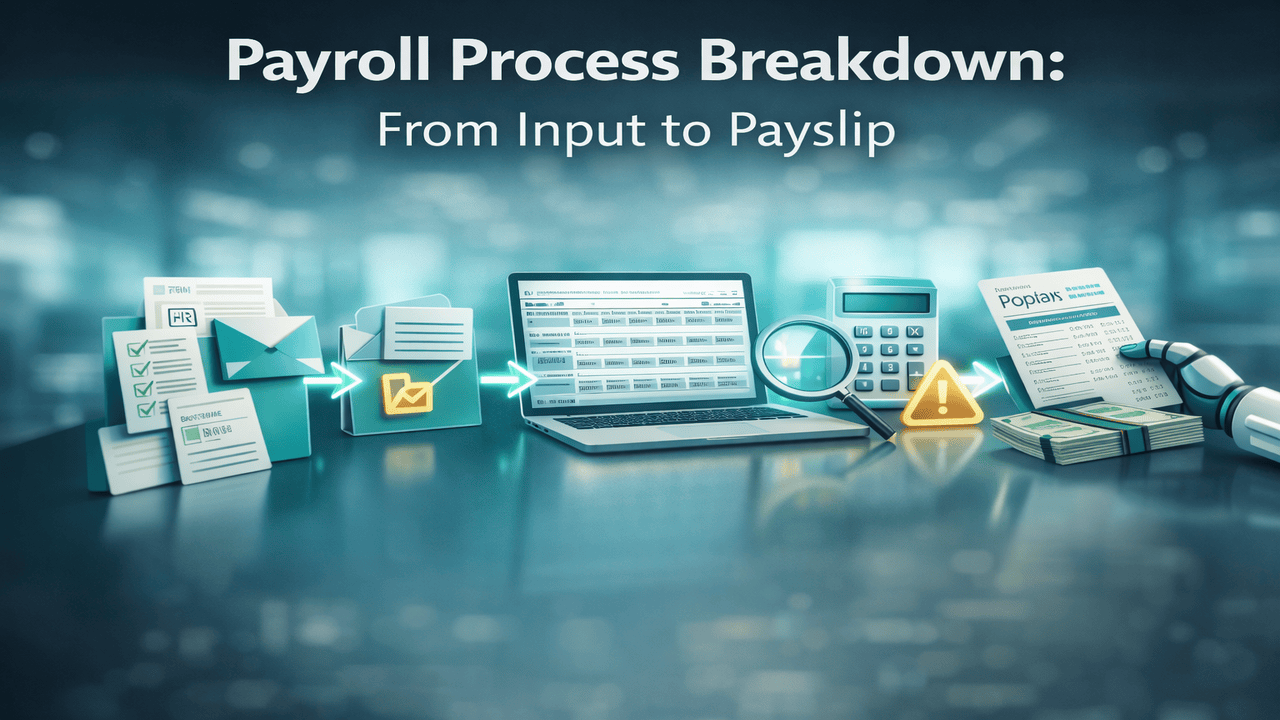
Payroll is often treated like a black box.
Data goes in.
Payslips come out.
But when something goes wrong, most businesses realize they don’t actually understand how payroll works end to end.
Let’s break down the entire payroll process, step by step — from the very first input to the final payslip.
🧠 Step 1: Payroll Inputs (Where Everything Begins)
Every payroll cycle starts with inputs.
This is also where most payroll problems originate.
Common payroll inputs include:
- Employee attendance
- Leave records
- Sick leave details
- Overtime data
- Deductions and adjustments
- HR approvals
If inputs are late, missing, or incorrect, payroll accuracy is already at risk.
📩 Step 2: HR & Employee Communication
Payroll data rarely arrives in a perfect format.
It usually comes via:
- Emails
- Attachments (PDFs, images)
- Messages
- Manual updates
This step is highly unstructured and error-prone, especially in manual payroll setups.
Missed emails here often mean missed payroll adjustments.
🧾 Step 3: Data Collection & Consolidation
At this stage, payroll teams:
- Gather data from multiple sources
- Consolidate inputs into spreadsheets or systems
- Match employee records manually
This step is time-consuming and highly dependent on human accuracy.
One incorrect consolidation can impact multiple payslips.
✅ Step 4: Validation & Checks
Before payroll can be processed, data must be validated.
Typical checks include:
- Leave dates vs attendance
- Sick leave certificates vs policy
- Deduction accuracy
- Missing or conflicting inputs
In manual systems, these checks are often rushed or incomplete.
⚠️ Step 5: Exception Handling
Not all payroll data is clean.
Exceptions include:
- Missing documents
- Policy conflicts
- Late approvals
- Data mismatches
These exceptions require human intervention and are a major cause of payroll delays.
💰 Step 6: Payroll Calculation
Once inputs are validated:
- Gross salary is calculated
- Deductions are applied
- Net pay is finalized
At this stage, payroll systems assume that all prior steps were done correctly.
If errors exist earlier, they flow directly into payslips.
⚖️ Step 7: Compliance & Final Approval
Before payroll is finalized:
- Compliance checks are performed
- Statutory deductions are reviewed
- Final approvals are given
In many businesses, this step happens under time pressure, increasing risk.
📄 Step 8: Payslip Generation & Distribution
Finally:
- Payslips are generated
- Employees are paid
- Documents are shared
At this point, fixing errors becomes expensive, visible, and disruptive.
🔍 Where Payroll Usually Breaks Down
Most payroll failures happen in:
- Input collection
- Manual validation
- Late exception handling
By the time payroll calculations begin, it’s often too late to prevent errors.
🤖 How Automation Improves the Payroll Process
Payroll automation improves every step by:
- Monitoring inputs continuously
- Validating data early
- Flagging issues before payroll day
- Reducing manual dependency
- Creating audit trails automatically
Automation shifts payroll from reactive fixing to proactive prevention.
🧠 Final Thoughts
Payroll is not just a calculation.
It’s a multi-step process, and every step matters.
Understanding the payroll process from input to payslip is the first step toward:
- Fewer errors
- Better compliance
- Happier employees
- Scalable operations
🤝 Simplify the Payroll Process with Payroll Robot
Payroll Robot uses AI agents to automate the entire payroll process — from input collection and validation to deductions and payslip accuracy.
Because payroll should be clear, predictable, and stress-free.
Comments are closed